Physical Asset & Metrology Management
Overview (/assets)
The Physical Asset Management module governs 202 analytical instruments, manufacturing skids, cleanroom utilities, and facility hardware units. It enforces strict separation between regulated GxP assets and Good Engineering Practice (GEP) non-regulated assets.
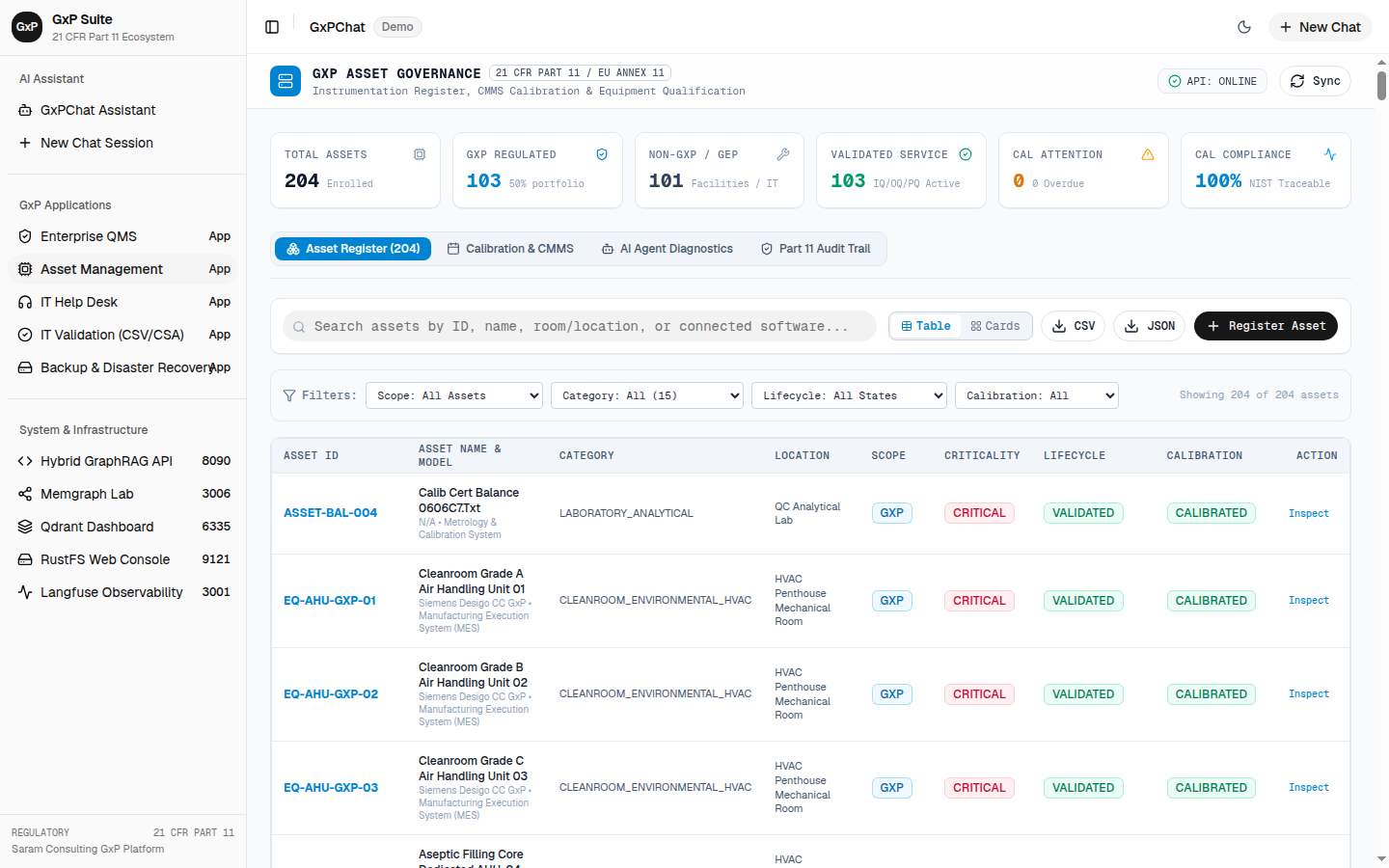
Master Asset Registry Architecture
The 202 seeded assets are divided into two distinct regulatory tiers:
1. GxP Regulated Assets (101 Units)
- Governed under 21 CFR Part 11, EU Annex 11, and ISO 13485:2016.
- Encompasses:
- Analytical Laboratory Instruments: HPLC/UPLC, GC-MS, ICP-MS, TOC Analyzers, UV-Vis Spectrophotometers.
- Upstream/Downstream Bioprocessing: 50L to 2000L Single-Use Bioreactors, Tangential Flow Filtration (TFF) Skids, Chromatography Skids.
- Critical Utilities: GMP Steam Autoclaves, Depyrogenation Ovens, Grade A/B Cleanroom Air Handling Units, -80°C Ultra-Low Freezers.
- Mandatory NIST-traceable calibration schedules, grace period enforcement (+/- 10%), and automated Out-of-Tolerance (OOT) deviation creation.
2. Non-GxP Enterprise & Facility Assets (101 Units)
- Governed under ISO 9001 and Good Engineering Practice (GEP).
- Encompasses:
- Commercial Office Facilities: Rooftop HVAC units, cafeteria chillers, data center in-row CRAC units.
- General IT Hardware: Developer laptops, meeting room AV consoles, office printers.
- Warehouse Logistics: Electric forklifts, pallet stretch wrappers, loading dock levelers.
- Maintains standard maintenance work orders without triggering Part 11 electronic signature requirements.
Key Capabilities
1. Multi-Attribute Filtering and Search
Users can filter the 202 assets by:
- Criticality: Direct GxP Impact, Indirect Impact, Non-GxP.
- Operational Status: In Service, Under Maintenance, Calibration Overdue, Decommissioned.
- Facility Location: Quality Control Lab, Biologics Pilot Plant, Cleanroom Suite 3, Central Utility Plant.
- Software Linkages: Filter by computerized systems controlling the hardware (for example, find all instruments attached to Empower CDS).
2. NIST Calibration Governance
- Displays last calibration date, certificate number, calibration interval, and next due date.
- Highlights overdue calibrations in high-contrast status badges.
- Overdue calibrations on GxP assets automatically trigger lockouts and alert the
AssetManagementAgentandCmmsMaintenanceAgent.
3. Hardware-to-Software Graph Linkages
In the Memgraph knowledge graph, physical assets are explicitly mapped to computerized systems:
(:Asset {tag: "EQ-HPLC-001"})-[:CONTROLLED_BY_SOFTWARE]->(:System {code: "CDS"})(:Asset {tag: "EQ-BIO-002"})-[:CONTROLLED_BY_SOFTWARE]->(:System {code: "MES"})When a software change control is initiated in the QMS, the system automatically traverses these edges to identify all impacted physical instruments requiring re-qualification.
Operational Use Case Scenario Workflows
Physical Asset Management enforces strict segregation between regulated manufacturing/laboratory equipment and standard facility hardware.
Scenario 1: Analytical HPLC Calibration Drift Out-of-Tolerance (OOT) Triage
sequenceDiagram    autonumber    actor Met as QC Metrologist    participant UI as Physical Assets Console (/assets)    participant AssetAgent as AssetManagementAgent    participant CmmsAgent as CmmsMaintenanceAgent    participant PG as PostgreSQL System of Record    participant CDS as Empower CDS Interface
    Met->>UI: Filters by "Calibration Overdue" & selects EQ-HPLC-001    UI->>AssetAgent: Audits calibration interval and tolerance limits    AssetAgent->>PG: Sets asset status to "Under Maintenance / Lockout"    AssetAgent->>CDS: Emits instrument lock signal preventing sample injection    AssetAgent->>CmmsAgent: Issues urgent work order WO-CAL-2026-11    CmmsAgent-->>UI: Dispatches NIST-traceable recalibration protocol    Met-->>UI: Uploads calibration certificate and restores "In Service" state
1. Context & Operational Pre-conditions
- Regulated Asset: Waters Alliance HPLC System
EQ-HPLC-001. - Governing Standards: 21 CFR § 211.68, 21 CFR § 211.160(b)(4), and ISO 17025.
- Condition: The instrument calibration interval elapsed without a certified re-calibration record on file.
2. Detection & Immediate Automated Containment
- The QC Metrologist opens
/assetsand observesEQ-HPLC-001flagged with a high-contrast status badge:Calibration Overdue. - The
AssetManagementAgenttriggers automated containment:- Updates asset operational state in PostgreSQL to
Under Maintenance / Lockout. - Sends an active lockout signal to the Empower Chromatography Data System (
CDS), preventing laboratory analysts from launching analytical sample sequences on the uncalibrated instrument. - Logs an Out-of-Tolerance (OOT) event in the QMS.
- Updates asset operational state in PostgreSQL to
3. Maintenance Work Order & NIST Calibration Execution
- The
CmmsMaintenanceAgentautomatically generates Work OrderWO-CAL-2026-11. - Certified external metrology technicians perform multipoint flow rate, wavelength accuracy, and pressure transducer calibration using NIST-traceable reference standards.
- The Metrologist uploads Calibration Certificate
NIST-CAL-99421directly through the asset modal dialog.
4. Re-Qualification & Return to Service
- The Metrologist executes standard system suitability testing (SST) per
SOP-QC-022. - The asset status transitions to
In Service. - The system clears the Empower CDS software lockout, and logs a 21 CFR Part 11 audit trail event confirming return to commercial testing status.
Scenario 2: New Bioreactor Skid Registration & MES Knowledge Graph Binding
1. Context & Operational Pre-conditions
- Facility Expansion: Installation of a new 500L Single-Use Bioreactor
EQ-BIO-005in Biologics Pilot Suite 2. - Automation Dependency: The skid will be controlled by Emerson DeltaV Manufacturing Execution System (
MES).
2. Asset Registration Workflow
- Automation Engineer navigates to
/assetsand clicksRegister Asset. - Fills out the registration form:
- Asset Tag:
EQ-BIO-005 - Classification:
Direct GxP Impact(Biopharmaceutical production skid) - Governing Standard: 21 CFR § 211.65, 21 CFR § 211.67, and ISO 13485:7.5.1
- Location: Biologics Pilot Plant - Suite 2
- Calibration Interval: 180 Days
- Controlling Software: Selects
MES (DeltaV)
- Asset Tag:
3. Knowledge Graph Topology Synthesis
Upon registration, the backend updates the Memgraph database:
MERGE (a:Asset {tag: "EQ-BIO-005", name: "500L Single-Use Bioreactor", criticality: "Direct GxP"})MERGE (s:System {code: "MES"})MERGE (a)-[:CONTROLLED_BY_SOFTWARE]->(s)MERGE (a)-[:LOCATED_IN]->(loc:Location {name: "Biologics Pilot Plant Suite 2"})The asset is immediately linked to the system-level validation requirements of DeltaV MES.
4. Qualification Protocol Dispatch
- The
/validationmodule automatically receives a notification of the newly registered GxP asset. - The
RequirementsTraceabilityAgentdrafts an Installation Qualification protocol (IQ-BIO-005) verifying electrical utility connections, sanitary clamp fittings, and DeltaV OPC-UA communication addresses.
Scenario 3: Non-GxP Facility Chiller Preventative Maintenance Workflow
1. Context & Operational Pre-conditions
- Equipment: Commercial Rooftop Chiller
EQ-CHILL-012servicing administrative office spaces. - Classification:
Non-GxP Enterprise / Facility Asset. - Governing Standard: ISO 9001 and Good Engineering Practice (GEP).
2. Maintenance Execution
- Facilities Technician accesses
/assets, filtering byCriticality: Non-GxP Enterprise. - Selects
EQ-CHILL-012to review scheduled semi-annual maintenance checklist:- Compressor refrigerant pressure check
- Intake fan belt tension inspection
- Air filter matrix replacement
- The technician checks off completed tasks and enters technician employee ID.
3. Regulatory Segregation & Governance
- Because the asset is flagged
Non-GxP, the system bypasses 21 CFR Part 11 electronic signature mandates and QA secondary verification. - Work order completion updates the CMMS ledger and schedules the next service interval for 180 days out without generating compliance deviations.