3-Database Division of Labor
Overview
In enterprise Life Sciences AI architectures, selecting a single database engine forces unacceptable compromises:
- Relational databases struggle with high-dimensional vector similarity scans at scale.
- Vector databases lack ACID transactions, complex relational joins, and cryptographic audit ledgers.
- Graph databases excel at multi-hop relationship traversal but are inefficient for dense vector indexing or raw text storage.
The platform resolves this by enforcing a strict Three-Database Division of Labor:
| Database Store | Primary Architectural Role | Query Engine / Syntax | Key Functional Strength | Anti-Pattern to Avoid |
|---|---|---|---|---|
PostgreSQL 16 (pgdata) | Authoritative System of Record (SoR), 21 CFR Part 11 Audit Trail, Relational RTM | Relational SQL, GROUP BY, tsvector @@, Foreign Keys | ACID transactions, append-only triggers, cryptographic manifests | High-dimensional vector scans at scale |
Qdrant (qdrant_data) | Semantic Retrieval Layer (Dense + Sparse) | Filtered ANN Search, Prefetch, Reciprocal Rank Fusion (RRF) | Sub-5ms retrieval latency, dense/sparse fusion, payload pre-filtering | Relational joins, aggregations, audit ledgers |
Memgraph MAGE (memgraph_data) | Structural Memory & Knowledge Graph Reasoning | Cypher Graph Queries, BFS, WSP, Multi-Hop Paths | In-memory C++ speed, transitive ripple effect analysis | Unstructured text dumps, blob storage |
PostgreSQL: Canonical Relational System of Record
PostgreSQL is the source of truth for all business and regulatory records:
controlled_documents: Version-controlled SOPs, specifications, and protocols with document status (DRAFT,EFFECTIVE,SUPERSEDED,WITHDRAWN).document_chunks: Decomposed text chunks indexed with SHA-256 integrity hashes.rtm_items: Relational V-Model linkage between URS, FS, DS, and Test Protocols.deviations&change_controls: Operational quality event records.audit_trail: Append-only 21 CFR Part 11 ledger capturing every insert and state mutation.gxp_backup_executions: Ledger of cloud snapshots and manual Qualified Person executions.
Immutability Trigger Enforcement
PostgreSQL enforces 21 CFR § 11.10(e) by binding PL/pgSQL triggers to critical tables:
CREATE OR REPLACE FUNCTION prevent_audit_trail_tampering()RETURNS TRIGGER AS $$BEGIN    RAISE EXCEPTION '21 CFR Part 11 Violation: Updates and deletes are prohibited on audit_trail records.';END;$$ LANGUAGE plpgsql;
CREATE TRIGGER trg_audit_trail_immutableBEFORE UPDATE OR DELETE ON audit_trailFOR EACH ROW EXECUTE FUNCTION prevent_audit_trail_tampering();
Qdrant: Semantic Retrieval Layer
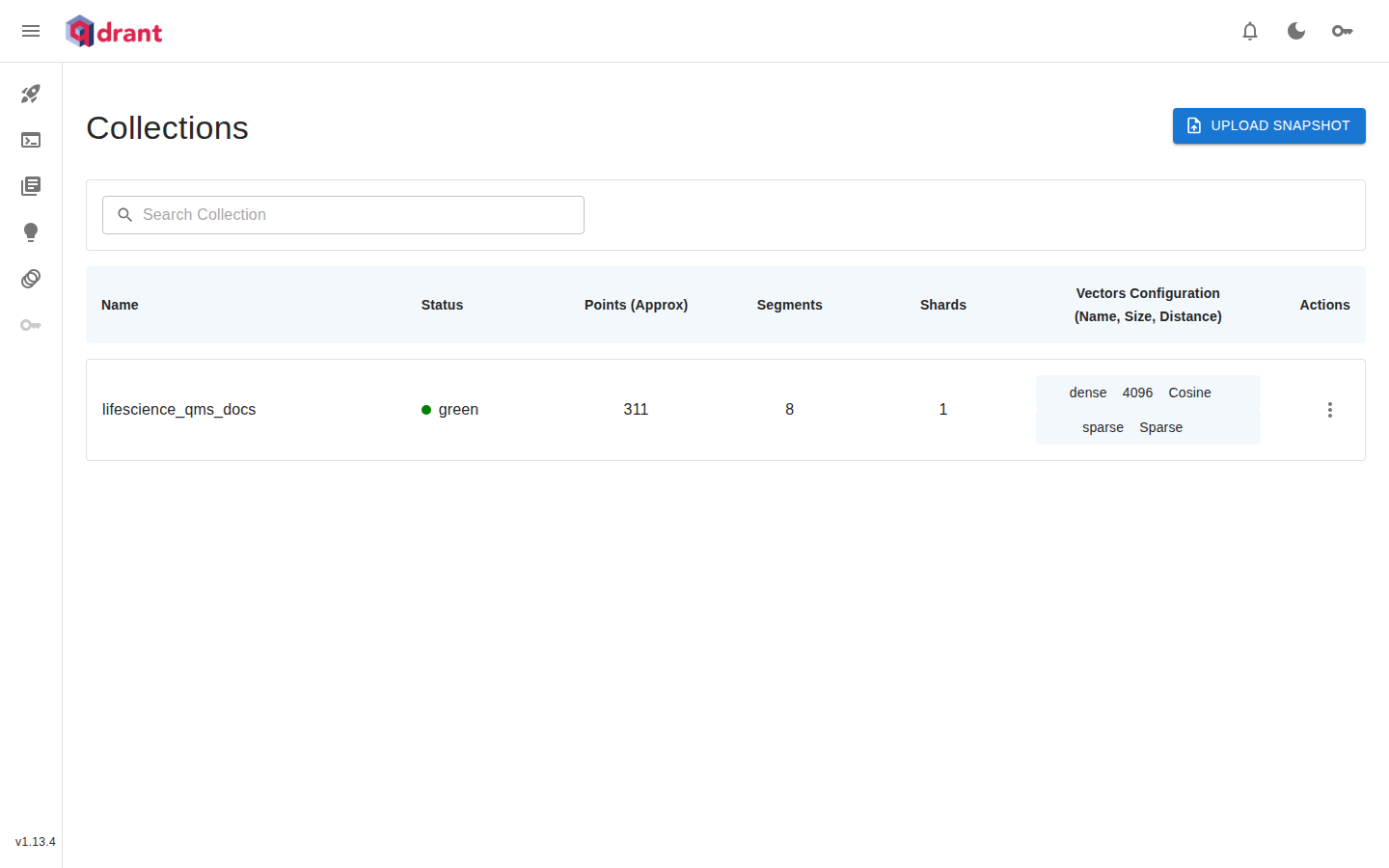
Qdrant (v1.13.4) indexes all document chunks using hybrid vector representations:
- Dense Vectors (4096 dimensions): Generated by
qwen3-embedding:8bvia Ollama or OpenAItext-embedding-3-large. Captures deep semantic meaning and conceptual proximity. - Sparse Vectors (SPLADE / BM25): Captures exact keyword hits, regulatory codes (e.g.
SOP-QA-045), and specific parameter values. - Payload Indexing: Every vector point stores metadata attributes:
document_id,system_code,gamp_category,is_superseded, andchunk_hash. - Pre-Filtering: Queries apply tenant and system filters directly in the vector index prior to similarity scoring.
Memgraph MAGE: Structural Knowledge Graph
Memgraph provides in-memory graph reasoning over a Labeled Property Graph (LPG):
- Nodes:
:Document,:Requirement,:Specification,:TestProtocol,:System,:Asset,:Deviation,:ChangeControl. - Relationships:
(:Requirement)-[:SPECIFIED_IN]->(:Document)(:TestProtocol)-[:VERIFIES]->(:Requirement)(:Deviation)-[:IMPACTS_SYSTEM]->(:System)(:Asset)-[:CONTROLLED_BY_SOFTWARE]->(:System)(:ChangeControl)-[:MODIFIES]->(:Requirement)
- Multi-Hop Traversal: When an engineering change control is submitted, Memgraph traverses downstream edges to instantly identify all test protocols, SOPs, and physical assets that must be re-qualified.